A bulldozer doesn't have a day off. Neither does a crane, a loader, or a mining truck. All of the moving joints need new grease, time and again. Skip one thing and that squeak at the corner of a machine's finger will turn into a costly fix.
That's when a Portable greasing system becomes handy. It allows your employees to access any grease point without moving from the machine. No more trips to the workshop, no more dosage calculations. In this blog, we will tell you how portable greasing systems work, list the available options, and give B2B buyers some guidance before investing.
Greasing Keeps Heavy Machines Alive
You must be thinking “what is greasing?” Greasing is the practice of applying grease, a thick, sticky lubricant, to the moving parts of a machine. The grease prevents metal-to-metal contact. It is applied to pins, bushings, bearings, and joints.
You can see why greasing is important . Grease puts a gentle barrier in between surfaces. It reduces friction and heat production and seals out dirt, mud, and water - all in the outdoor environment of a construction or mining site. Several maintenance projects tie contaminated grease to bearing failure.
A grease point may be a tiny thing. But on a big excavator, dozens of them, with one dry pin can load the whole arm. Without grease, parts wear rapidly, and an unplanned breakdown comes at the worst possible time. Planned greasing costs so little. Unplanned downtime costs everything.
Types of Greasing You Will Meet
Buyers wonder which Type of greasing works for their fleet. Each method has its advantages; the key is understanding your machine's daily operation.
| Type of Greasing | How It Works | Best For |
|---|---|---|
| Manual greasing | A worker presses a hand lever grease gun on each point. It is simple and low cost, but it depends on the person. | Small jobs and a few machines |
| Semi-automatic greasing | A pump, run by air or a motor, pushes the grease. A worker still connects it to each point. | Workshops that want faster, steadier greasing |
| Automatic greasing | A central pump sends grease to many points on a timer. | One machine that runs long hours |
| Portable greasing | A mobile unit moves from machine to machine and gives power-assisted greasing anywhere. | Fleets spread across many machines or sites |
For fixed, automatic set ups, you want one machine that never stops. For portable sets you are able to manage many sets of machines or multiple locations.
How a Portable Greasing System Works
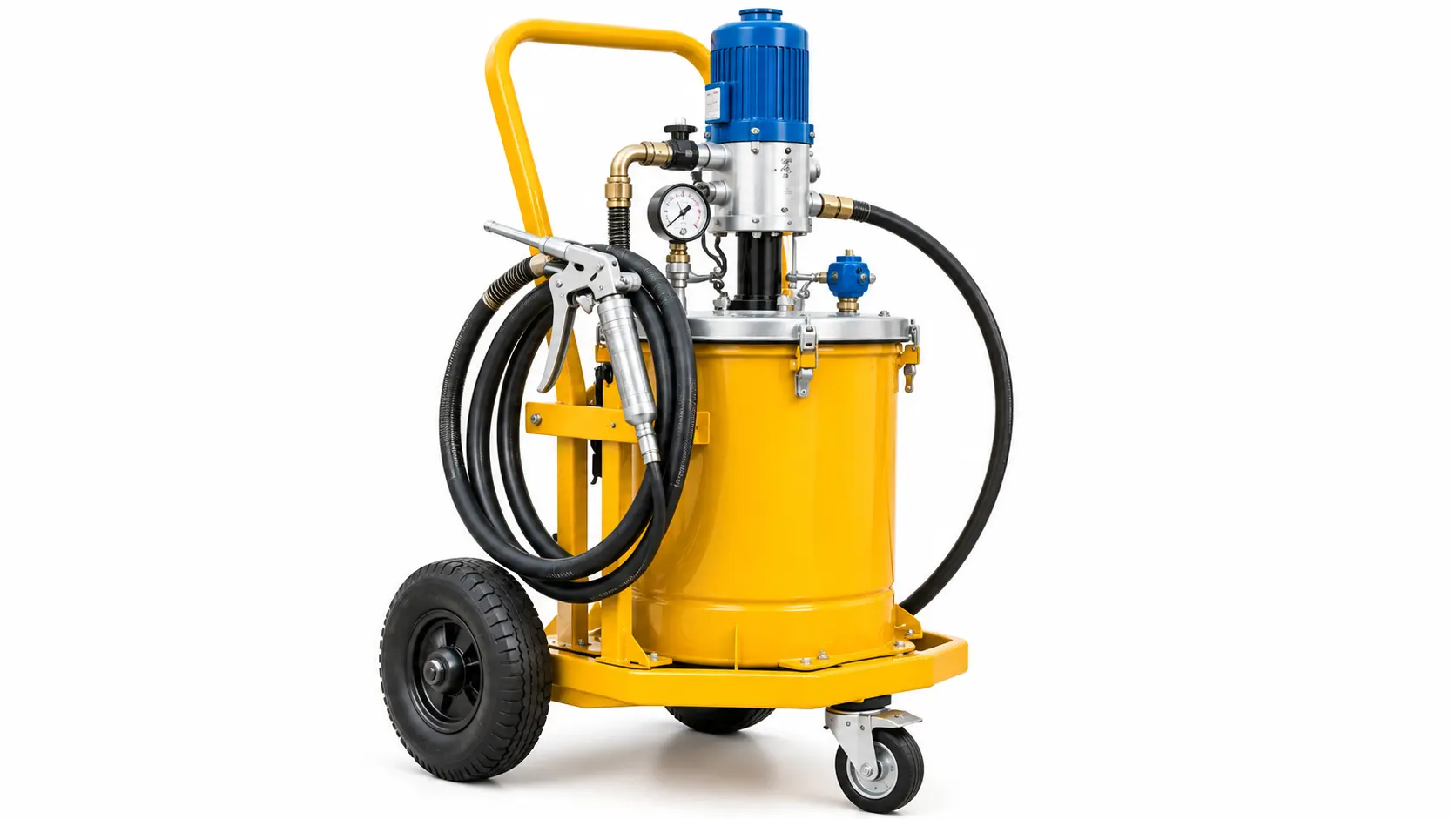
A Portable greasing machine is a small-sized pump mounted on a trolley or wheels. It contains the grease in a drum or cartridge, an engine, an air feed, or a battery, which powers the pump.
Imagine it like the bike pump you use for your tires, but with grease. It applies consistent force to travel through the pipe to the tight corners. You would never be able to pump using just your hands.
A Portable grease gun might suffice for smaller jobs. Battery-powered versions are available on many jobsites. It takes only a few minutes to grease a loader with one, and it takes minimal effort. For larger fleets, consider a portable system that includes a larger tank and hose, which would save more time. Some also include a pressure gauge or flow meter, so you know how much grease each point received.
Since the unit is mobile, it makes it easy to schedule your rounds. You can decide on a greasing round at the beginning of each shift, and still make it to each machine on a single pass.
Where Portable Systems Fit Best
The cost-effective system is good for companies that have an on-the-go or shared repair environment. These are the places where the customers see good results every day.
- Construction sites with excavators, loaders, and cranes.
- Mining and quarrying working with large dump trucks.
- Farm fleets with tractors and harvesters.
- Plant maintenance crews servicing a large number of machines during a single shift.
- Remote locations where a fixed installation is difficult to mount.
The machine can be used on ten containers at the same time. Due to this, the cost of one is low.
Common Greasing Mistakes to Avoid
The most modern machine doesn't make up for bad habits. Teams typically get hold of just a handful of minor problems that wear the machines out faster - and each one can be addressed simply while training.
- Excessive lubrication that expels out the seals and attracts dust.
- Under-greasing, which leaves parts dry between services.
- Incompatibility of greases, which can cause lubricant degeneration.
- Not doing the nozzle wipe, which buries the old dirt into the joint.
- By passing the support plan in the maker's guide
A quick, one-item check on each machine corrects most of this. Show your operators one time, and the behavior remains.
Benefits for Your Business
For the B2B buyer, the case is (almost) all about the numbers. Here's what you get. More uptime begins first. Consistent, proper lubrication prevents costly breakdowns, keeping equipment in production for more hours each year. And repair costs decrease as well as bearings and other components last longer when they're properly lubricated. Waste goes down too. With a metered feed each location gets exactly what it needs. If you pump grease in too high of a volume, it wastes product and can blow out seals. Closed piping and pressure wash out nozzles prevent spills on the floor. Your team also wins. Reduced-greasing power means less frequent hard pumps, less climbing around and over long machines and less awkward reaching for high equipment. Certain systems track what quantity of grease has been used to support service records and audits.
What to Check Before You Buy
Doesn't every unit work for every fleet? Have you run through this list with the head of maintenance before you order?
- Pump pressure and flow rate which is tailored to your machines' grease points.
- Full shift tank or drum capacity before fill up.
- Power source: air, electric or battery, according to what you have available at your site.
- Hose length and quality, tough sites will end up destroying weak hoses quickly.
Why Choose Techno Drop Engineers
A greasing system is only as good as the operators. Techno Drop Engineers work in lubrication systems for heavy machinery so we know what your plant and site teams face on a day to day basis.
- Supported advice custom made to your machines, type of grease and work hours.
- Durable parts made to withstand dust, heat, and rough wear.
- Easy to operate with simple layouts that your operators will be able to learn quickly.
- Straightforward advice prior to buying and once installed.
We tell you what we think. If we believe a portable unit is right for you, we will recommend it. If a truck-mounted solution is better, we say it.
Conclusion
Heavy equipment makes money when it runs. Grease is the unsung hero that keeps it running. A mobile greasing system puts that unsung hero to work quickly, evenly and consistently on a wide variety of equipment. Identify your needs, review the pump, tank and mounting/support options and choose a partner willing and able to communicate. Techno Drop Engineers is here to help you make your greasing program a success.
|
Looking to reduce downtime and extend equipment life? Get in touch with Techno Drop Engineers today to chat about your equipment and get professional advice and pricing on the best portable greasing solution for heavy equipment. |
FAQs
1. What is a portable greasing system?
The pump itself can be moved from machine to machine, workshop to site. It is a mobile pump unit that can deliver grease to machines via a hose and nozzle. This provides your team with power-assisted greasing anywhere your machines are parked.
2. How often should heavy equipment be greased?
Many machines will require grease once each shift, or once every 8 to 10 working hours. Dusty, damp or heavy-duty jobsites will require more of it.
3. Is a portable grease gun enough for a large fleet?
A small grease gun is ideal for small jobs and occasional topping up. For a much larger fleet, a portable greasing machine is much faster and results are more uniform. It also saves your team lots of time and effort.
4. Can one unit handle different grease grades?
Some units have multiple, as long as the pump is compatible with the viscosities of the grease. Ask your vendor before you change. Flush out the lines when you change grades so the greases do not mix.
5. How does a portable system save money?
It minimizes downtime, minimizes grease waste and enhances wear life. Less equipment repairs equate to less repairs. One unit can be used with a lot of equipment which helps drive your per machine cost down.
6. What should I check before buying?
Read off the gauge pressure, flow, tank capacity, power source, quality of hose. Make sure it is compatible with the grease grades you use. Also ensure you can get spare parts and after sales support easily.