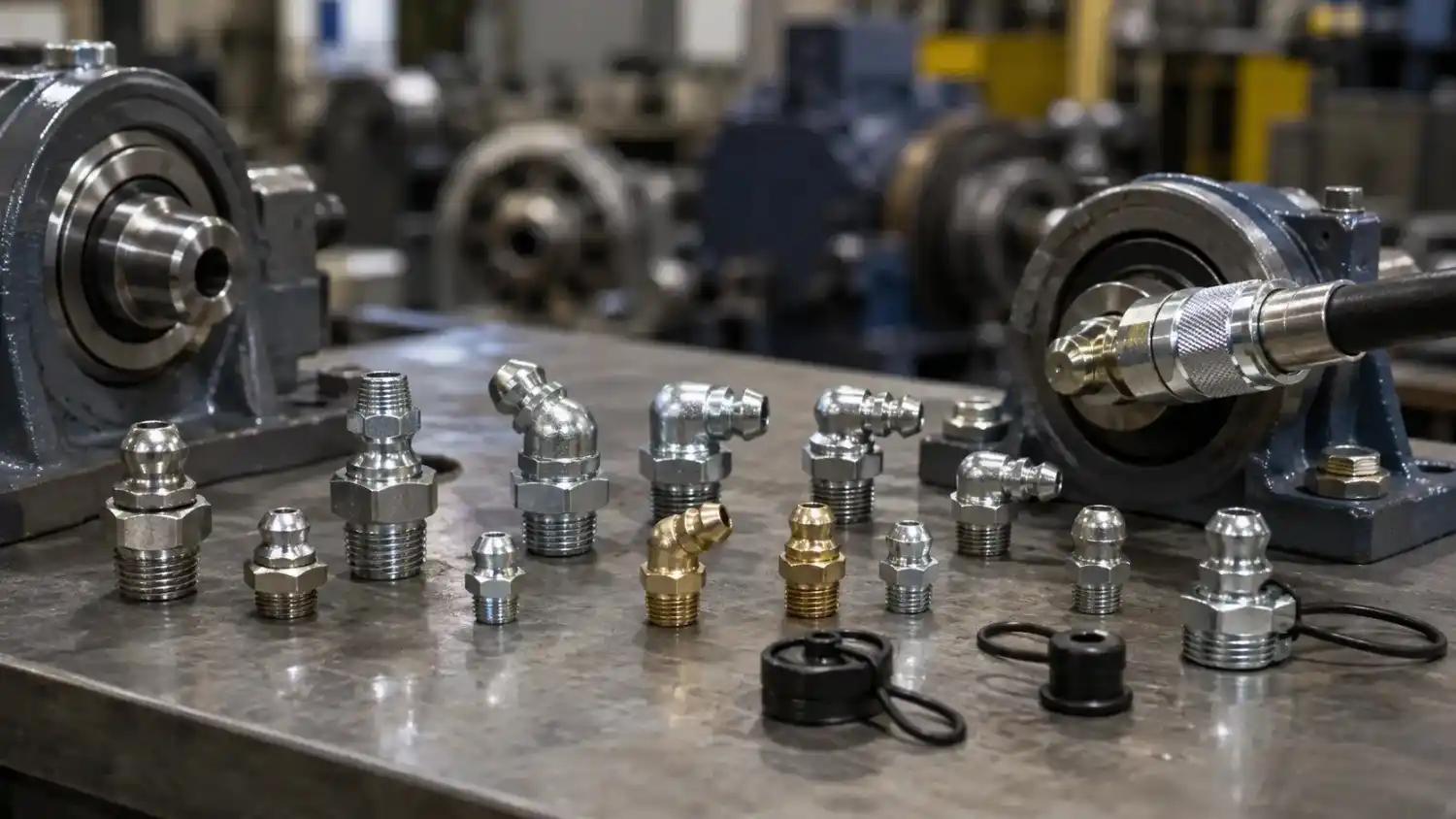
A machine runs on hundreds of small parts, and grease has to reach every one somehow. That's where Lubrication Fittings come in. They don't get much attention until one goes missing or clogs up, and a bearing that should've lasted years starts making noise after a few months instead. Rolling mills, conveyor lines, packaging units — the parts change, but the fitting still does the same job: let grease in, keep everything else out.
Get it wrong and the signs show up fast — leaking grease, blocked Lubrication Points, dirt working its way in. This piece covers Grease Nipple Types, what to look for in the material, and a handful of tips picked up from people who deal with this on the shop floor every day.
What Is a Lubrication Fitting?
Think of it as a doorway. A lubrication fitting sits on a bearing, bushing, or moving joint, and its purpose is letting grease or oil through without anyone pulling the machine apart. People also call these Grease Fittings — same part, different name depending on who's asking. Either way, it's the point where a grease gun meets the machine's insides.
Inside most of them is a tiny spring-loaded ball. Push grease in, the ball opens, grease flows through. Stop pushing, it closes again, and nothing gets back in the other way — not dirt, not moisture. Put a fitting like this together with adaptors, caps, and cartridges, and that's the whole toolkit of Lubrication System Components a plant needs to keep running smoothly. Forget a proper Grease Nipple somewhere, and it doesn't matter how good the grease is — it's simply not getting where it's supposed to.
Why Lubrication Fittings Matter
Machines rarely fail overnight. Efficiency drops slowly, and poor lubrication is usually sitting somewhere behind it. Fittings control how easily grease reaches bearings, pins, and shafts — the points actually doing the work. Get the fitting wrong, or let it wear past its prime, and this is what shows up:
- Grease leaking out instead of going in
- Lubrication points clogging up over time
- Dust and moisture creeping in where they shouldn't
- More friction, more heat
- Downtime nobody planned for
None of that sounds dramatic alone. Add it up across a plant running dozens of Lubrication Accessories, and it's a surprising amount of avoidable work — fixed largely by standardising fitting choices across similar machines.
Grease Nipple Types and Fittings
Not every mounting point looks the same, so Grease Nipple Types come in a handful of shapes to match different angles, threads, and access conditions:
- Straight nipples — the easy, direct spots
- 45-degree nipples — for when straight-on access isn't there
- 90-degree nipples — built for tight, recessed corners
- Flush-type nipples — sit low so nothing knocks them off
- Button-head nipples — made for high-pressure grease guns
- Drive-fit nipples — pressed straight into the housing, no threads needed
That's the nipples covered. Zoom out a bit further and Grease Fitting Types also take in pipe fittings, adaptors for reaching into the spots nobody wants to reach, and metering cartridges that decide exactly how much grease lands where. Nobody wants to learn the hard way that these Grease Nipple Fittings aren't interchangeable — get the right one from the start, and it won't be leaking six months down the line.
Features to Look For
Worth running through a short checklist before ordering:
- Thread size and type — metric or BSP, don't assume
- Material — brass does fine in most places; stainless steel earns its cost in corrosive or washdown areas
- A ball-check valve that actually holds, not one that fails quietly
- A cap, because dust doesn't wait for a gap to appear
- Pressure rating that matches the grease gun in use
- Small enough to actually sit where it needs to go
Get these right and it cuts down one of the most preventable causes of bearing failure — grease bypassing the joint entirely.
|
Trivia Grease nipples are also called Zerk fittings — named after Oscar U. Zerk, who patented the spring-loaded design back in the 1920s. |
Product Overview
We stock the full spread of Lubrication Accessories a maintenance store actually needs — grease nipples in every angle and thread size worth having, grease gun nipples built for repeated high-pressure use, protective Grease Nipple caps, and Grease Nipple adaptors for the awkward spots nobody wants to redesign around. Lubrication cartridges and metering cartridges are in there too, along with the pipe fittings that connect distribution blocks back to individual Lubrication Points. Standard thread profiles throughout, so swapping a part doesn't turn into a project.
Benefits of Choosing the Right Fittings
Some of the benefits are:
- Grease actually reaches every lubrication point, consistently
- Less friction and wear, fewer surprise breakdowns
- Lower grease consumption, cleaner workspace
- Maintenance rounds move faster
- Bearings and components simply last longer
- Better odds in dusty, wet, or otherwise rough environments
Add it up over a few months and it shows up as fewer callouts, plus uptime that's actually easier to plan around.
Applications and Use Cases
You'll find Lubrication Fittings in steel plants, cement units, power stations, packaging lines — pretty much anywhere a machine has rotating or sliding parts. Bearings, pins, bushings, chains, slides, all of it needs a fitting to accept grease safely. Centralized system or someone walking the floor with a grease gun, the fittings do the same job either way, and they're some of the most-used Lubrication Components across Indian industry. Even smaller workshops rely on the same basic parts for pumps and motors.
|
Did You Know? A blocked grease nipple doesn't just stop working quietly. It can make a bearing fail several times faster than one that's lubricated the way it should be. |
Comparison Table: Fitting Types at a Glance
Understand the product better through the comparison table:
| Fitting Type | Best Suited For | Access Requirement |
|---|---|---|
| Straight Nipple | Open, easily reachable points | Direct straight-line access |
| 45-Degree Nipple | Semi-obstructed mounting areas | Angled clearance needed |
| 90-Degree Nipple | Recessed or tight housings | Minimal side clearance |
| Flush-Type Fitting | Exposed surfaces prone to knocks | Level, low-profile access |
| Button-Head Fitting | High-pressure greasing routines | Compatible grease gun coupler |
| Drive-Fit Fitting | Non-threaded housing bores | Press-fit installation space |
Expert Tips and Buying Guide
Here are the major expert tips and buying guide:
- Check the mounting space before ordering, not after
- Keep spare caps around — dust doesn't wait for a scheduled service
- Stainless steel earns its cost in humid or washdown areas
- Check ball-check valves now and then; grease backflow isn't always obvious
- Standardise across similar machines wherever it's practical
- Buy from someone who stocks fittings and adaptors together — saves a second order
|
Fact Most industrial grease nipples come in just three common thread sizes — enough to cover the majority of standard bearings out there. |
About Techno Drop Engineers
Techno Drop Engineers is a reputed manufacturer of centralized and automated lubrication systems in India. Founded in 1999, the organization concentrates on offering reliable lubricating products for improving efficiency and increasing durability of machines with 26+ years of experience. The organization offers its lubrication systems to diverse sectors such as steel plants, cement works, thermal power plants, mines, and manufacturing units. Techno Drop Engineers is run by Sagar Kaushik. Some important features of Techno Drop Engineers include quality products, experienced engineers, quality manufacturing processes, and excellent customer support services.
FAQs
1. What is a lubrication fitting used for?
A lubrication fitting lets grease or oil into a bearing, bushing, or joint without opening up the machine. It works like a one-way gate — push grease in, and a spring-loaded ball stops it from coming back out. Without one fitted properly, even good grease just won't reach the part that needs it.
2. How do I know which grease nipple type to use?
Honestly, it comes down to whatever space you're working with. Got open, easy access? A straight nipple's fine. Something tucked into a corner needs an angled one — 45 or 90 degrees, depending how tight it is. Surfaces that take a beating do better with flush-type, and high-pressure guns pair best with button-head.
3. How often should grease nipples be checked or replaced?
There isn't really a set schedule for this — it's more about paying attention during the rounds you're already doing. Grease not going in easily? Visible leak? Cap missing? Those are your signs. And once a ball-check valve won't hold anymore, don't bother nursing it along — just swap the fitting.
4. What's the difference between a grease nipple and a grease fitting?
Not much, honestly — most people on the floor use both words for the same thing. If you want to split hairs, grease fitting is the umbrella term, covering nipples, adaptors, pipe connectors, the lot. Grease nipple usually means that one specific part sitting on the bearing where the gun connects.
5. Why does a blocked grease nipple cause bearing damage?
Once a nipple clogs, grease stops reaching the bearing surface, but the wear inside doesn't stop with it. Metal keeps grinding against metal without any cushion, and heat builds up fast. A bearing running dry like this can fail several times quicker than one greased on schedule.
6. Can I mix different grease nipple types on the same machine?
You can, and plenty of machines do — different mounting points often need different angles or thread sizes anyway. Just make sure every nipple matches its coupler and thread type correctly. Mixing types isn't the issue; mismatched threads or worn ball-check valves are what usually cause the real trouble.
Conclusion
Lubrication fittings are small. That's exactly why they get overlooked, right up until a bearing fails and someone traces it back to a blocked or mismatched part. Getting the Grease Nipple, adaptor, or cartridge right for each lubrication point isn't complicated. It just takes a bit of attention up front — and it saves a lot more downtime than people expect.
| Explore our range of grease nipples, adaptors, and lubrication fittings, or Contact Us and let Techno Drop help you find the right solution for your application. |